Upcoming Event: Swimming & Diving versus Blue/White Week on September 13, 2026

Swimming & Diving
vs Blue/White Week


11/2/2007 12:00:00 AM | Swimming & Diving
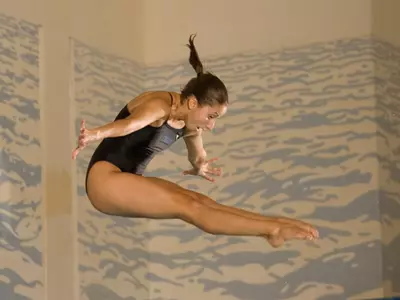
DURHAM, N.C. ? The four members of Duke's varsity diving team have gone through entire practice sessions this fall without ever getting wet. Instead of plunging repeatedly into the well at the Taishoff Aquatics Pavilion, they sometimes work to perfect their form in dry dock with the aid of trampolines and belts at nearby Card Gym.
It's all part of a different twist on training introduced by new head diving coach Drew Johansen, who's intent on making a big splash with a program that heretofore has attracted only minimal attention.
Johansen was named Duke's diving coach last summer, and his selection immediately signaled a change in direction for a subset of the swimming program that previously had been guided by part-time coaches and volunteers. Johansen is a USA Diving national team coach who had been running one of the top diving clubs in the country in Columbus, Ohio, and now he's introducing a new approach to the sport at Duke.
“When we advertised the position, I knew it would spark some interest, but I never imagined we could hire Drew Johansen,” said Dan Colella, Duke's head swimming coach. “We are thrilled to have him. One of my close friends in diving told me this summer that when we pulled this off, this was one of the biggest coups in diving in several decades, so we're excited.”
Several factors converged to create the union between Johansen and Duke. One was the athletic administration's decision to make the diving coach a fulltime position. The previous diving coach, Andy Scott, had done some fine work in developing a few NCAA zone qualifers during his five years, but his job was classified as part-time. He also had a fulltime job as a middle school science teacher in Durham. When Scott decided to move to San Antonio last spring, Colella convinced his superiors that the diving job needed to be elevated.
Another factor that attracted Johansen was Duke's willingness to allow him to establish a club diving team unrelated to the varsity but able to use the facilities and staff expertise. The club, part of the American School for Diving, is a year-round program that combines education and life skills with expert diving instruction for youth in the community who are interested in getting serious with the sport.
The club team has attracted several kids from the area so far and also already serves as the home training ground for three 2008 Olympic hopefuls ? high school junior Nick McCrory of Chapel Hill, high school senior Abby Johnston of Durham and 24-year-old Mitch Richeson, an Ohio State graduate who was the national champion in synchronized diving the past two years.
Richeson and Johnston were members of Johansen's club team in Columbus and followed him to Durham to continue training under his direction. Johnston was the Ohio state prep champion last year, while placing third at junior nationals and eighth at senior nationals during the summer.
Johansen's assistant coach is Jenny Keim, who competed in the 1996 and 2000 Olympics and was a two-time NCAA champion at Miami in 1999 and 2000. Keim is considered a volunteer coach for the Blue Devils and fulltime with the club. The combination of Johansen's coaching prowess and Keim's recent success in the sport makes for an attractive package at Duke.
“He will develop a lot of great divers,” Colella said. “Just look at Ohio State, which has one of the premier diving programs in the country. Probably half the people on the diving roster came out of his club program there in Columbus. Our hopes are to do exactly the same.
“It's a great opportunity for the community to have not only Drew but also Jenny Keim working with the program. He's only been here about two months and they already have about 20 or 22 divers on the team. There is some real talent in the area and we'd love to keep some of that right here.”
Of course, Colella is most excited about the potential impact of a strong diving team on the Duke program. He pointed out that Miami had two divers at the NCAA meet last year and their points enabled the Hurricanes to place 18th in the country. The Blue Devils operate a mostly non-scholarship swimming program, with ACC champions and NCAA qualifiers a rarity since the days of Duke Sports Hall of Famers Eric Steinhouse and Nancy Hogshead over a quarter-century ago.
But athletics director Joe Alleva has indicated that scholarship assistance could be made available for elite, national-caliber prospects interested in Duke, with more aid forthcoming if the progress warrants it.
“It's swimming and diving,” Colella noted. “Points are points, and the divers will score a lot of points for us. And we feel pretty good that on the swimming side, we'll be getting more kids to the NCAAs also.
“But not only that. Like swimmers, divers tend to be great student-athletes and are really attracted to institutions like Duke.”
With Johansen's arrival, Duke has agreed to provide additional training facilities for diving, including gym space where he can employ his land-based techniques. His approach has been heavily influenced by time he has spent living and studying at China's national training center in Beijing ? home of some of the world's foremost divers and coaches.
“We use a different style of training than has traditionally been done,” Johansen explained. “We have a gym-first approach and the university is developing a dry-land center for us where we're going to practice all of our dives on trampolines and on diving boards that land in mats with pulley and ropes over them. That really has been the key to our success over the last eight to ten years.
Duke has embraced that and understands it and is creating that facility for the varsity program. The club will have the benefit of being able to use it, too.”
“I feel like we have one of the best facilities in the country now,” said junior diver Lauren Gonzalez. “We'll do an entire practice out of the water and it's all stuff that works on the mechanics of diving. We may be on the board diving into the water less than we were before, but everything we're doing out of the water is going to make that water training so much more effective.”
Gonzalez, fellow junior Nick Campisano and sophomores Julie Brummond and Eric Winnard make up the Duke diving team this year. Three of the four made the NCAA zone meet last year, with Brummond reaching the finals. They don't interact with the club team, which practices at different times than the varsity, but they recognize the potential benefits of having top talents being exposed to their program and working with their coaching staff on a regular basis.
“In the past I don't think Duke would have been on their radar,” Gonzalez said. “We had a part-time coach and the diving program wasn't too strongly developed. But now that he's here, there are a bunch of people who in the summer weren't even looking at Duke, and now they're hearing about how supportive the athletic program is, and they are definitely excited about looking at the school.”
“I think we'll be able to attract some of the best young athletes who will be able to battle for ACC championship titles, NCAA titles and even make runs at the Olympic Games in 2012,” Johansen said.
The club team is officially known as Blue Devil Diving and is part of the American School for Diving, which has a second location at East Stroudsburg State in Pennsylvania (the Squires Fliers). Johansen is hopeful of opening two more locations over the next five years.
“It's a new concept and we'll move slowly with it,” he said. “The structure is the blending of a club sport with the support of a university. It's a new way of offering youth sports with an educational philosophy about it. We can offer youth sports to kids as young as four or five years old, give them an activity that brings some structure to their life, teach them some accountability, responsibility and discipline, all those things that can open doors for them in the educational world by potentially being a student-athlete who can go on to college, potentially getting a scholarship or getting into some of the higher-end schools because of their sport.
“It's a model that we will be promoting and encouraging other schools to use.”